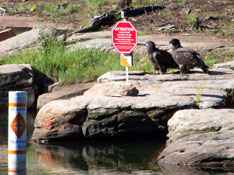
The bald eagle was federally listed as an endangered species in 1978. By 1995, the birds had recovered enough to be considered a "threatened species." Despite increasing demands for water-related recreation and growing human populations throughout Arizona, the bald eagle population has continued to grow and was removed from the endangered species list in 2007. Part of the reason for the comeback in the state is the statewide management efforts of the Southwestern Bald Eagle Management Committee (SWBEMC). During Endangered Species Act listing, the SWBEMC developed a variety of management programs that helped
ensure the reproductive success of Arizona’s breeding bald eagles. These efforts include: some seasonal closures of
sensitive bald eagle breeding areas and the Arizona Bald Eagle Nestwatch Program, which contracts individuals to
monitor breeding areas, educate the public about these breeding area closures and identify situations where
intervention might be needed to save an eagle's life. By continuing these and other management actions, the bald
eagle will continue to thrive in Arizona.
In December, land and wildlife management agencies enact the seasonal breeding area closures. During this time, bald
eagles are rebuilding nests and courting in preparation for egg laying. This is also a time when bald eagles are very
sensitive to human activity, which can cause a breeding pair to abandon the breeding attempt. Once eggs are laid, a
disturbance lasting 15 to 30 minutes can cause the breeding attempt to fail. Accordingly, land management and
wildlife officials ask for your help in protecting Arizona's bald eagles by honoring the bald eagle closures
throughout the state. Information on individual closures can be found below.
Closure Information
Airspace Advisory
Statewide – The Federal Aviation Administration (FAA) has established a 2000-foot above ground level (AGL) advisory along the Salt and Verde river drainages. When traveling in these drainages or near riparian habitat statewide, aircraft should maintain a minimum of 2000-foot AGL to ensure compliance with state and federal law.
Seasonal Closures
Alamo Lake
Alamo Lake - A portion of upper Alamo Lake may be closed to boats from January 1 to June 30. Contact the Arizona Game and Fish Department, Region IV, Yuma, (928) 342-0091.
Lake Pleasant
Lake Pleasant - No vehicle, watercraft, or foot entry is allowed into the Lower Agua Fria Arm from December 15 to June 15. Contact Maricopa County Parks and Recreation, (928) 501-1710.
Verde River
- A closure for the Verde River below Sycamore Canyon Wilderness (Tower) is not planned this year unless the eagle pair resumes nesting. Contact Coconino National Forest, Sedona Ranger District, (928) 282-4119.
- Verde River near Chasm Creek (Ladders) is closed to foot and vehicle entry from December 1 to June 15. Boating through is allowed. Contact Prescott National Forest, Verde Ranger District, (928) 567-4121.
- Verde River near Cold Water Creek, allows watercraft to float through but no stopping on the river or landing is allowed from Dec. 1 to June 30. Contact Prescott National Forest, Verde Ranger District, (928) 567-4121
- Verde River upstream of East Verde confluence is closed to vehicle and foot entry from December 1 to June 30. Floating through is allowed, but there is no stopping in the river or landing allowed from December 1 to June 30. Contact Tonto National Forest, Cave Creek Ranger District, (480) 595-3300.
- Verde River near Mule Shoe Bend (Table Mountain) allows watercraft to float through, but there is no stopping in the river or landing allowed from December 1 to June 30. Contact Tonto National Forest, Cave Creek Ranger District, (480) 595-3300.
- Verde River below Horseshoe Dam (Cliff) is closed to vehicle and foot entry on the southwest side of the river from December 1 to June 30. Floating through is allowed, but no stopping in the river or landing on the southwest side of the river is permitted. Contact Tonto National Forest, Cave Creek Ranger District, (480) 595-3300.
- A portion of Horseshoe Reservoir may be closed to watercraft from December 1 to June 30. Contact Tonto National Forest, Cave Creek Ranger District, (480) 595-3300.
- Verde River below Bartlett Dam is closed to foot and vehicle entry from December 1 to June 30. Boating through is allowed, but no stopping in the river or landing is permitted. Contact Tonto National Forest, Cave Creek Ranger District, (480) 595-3300.
- Verde River at the Needle Rock Recreation area (Needle Rock / Box Bar) is closed to foot and vehicle entry on the east side of the river from
December 1 to June 30. Floating through is allowed, but no stopping in the river or landing on the east side of the river
is permitted. A small area on the west side may also be closed depending on nesting locations. Contact Tonto National Forest, Cave Creek Ranger District, (480) 595-3300.
Tonto Creek
- Tonto Creek from Gisela to 76 Ranch is closed to vehicle and foot entry and floating through from December 1 to June 30. Contact Tonto National Forest, Tonto Basin Ranger District, (928) 467-3200.
- Tonto Creek inlet to Roosevelt Lake is closed to vehicle and foot entry within 1,000 feet of the nest on land, and to watercrafts within 300 feet on water from December 1 to June 30. Contact Tonto National Forest, Tonto Basin Ranger District, (928) 467-3200.
Salt River
- Salt River from Horseshoe Bend to Redmond Flat allows watercrafts to float through, but no landing or stopping in the river is permitted from December 1 to June 30. Contact Tonto National Forest, Globe Ranger District, (928) 402-6200.
- Salt River near Meddler Point (Pinto) is closed to vehicle and foot entry within 1,000 feet of the nest on land, and to watercrafts within 300 feet on water from December 1 to June 30. Contact Tonto National Forest, Tonto Basin Ranger District, (928) 467-3200.
- Salt River near Campaign Bay may be closed to vehicle and foot entry within 1000 feet of the nest on land, and to watercraft within 300 feet on water from Dec. 1 to June 30. Contact Tonto National Forest, Tonto Basin Ranger District (928) 467-3200.
- Salt River below Stewart Mountain Dam (Blue Point / Bulldog) is closed to vehicle and foot entry on the south side of the river from December 1 to
June 30. Floating through is allowed. Contact the Tonto National Forest, Mesa Ranger District, (480) 610-3300.
- Salt River below Stewart Mountain Dam (Goldfield) and near Goldfield-Kerr Fire Station is closed to vehicle and foot entry on the north side of the river from December 1 to June 30. Floating through is allowed. Contact the Tonto National Forest, Mesa Ranger District, (480) 610-3300.
Crescent Lake
At
Crescent Lake, a portion of the entrance road may be restricted to a “no stopping zone” and a portion of land near the parking area may be closed to foot entry from April 1 through July 30. Contact the Apache Sitgreaves National Forest, Springerville Ranger District, (928) 333-4372.
Luna Lake
Luna Lake is closed to vehicle and foot traffic on the north side from January 1 to June 30. The area adjacent to the nesting closure on the upper end of the lake is closed from February 15 to July 31. Contact Apache National Forest, Alpine Ranger District, (928) 339-4384.
Lynx Lake
The area between
Lynx Lake and Salida Gulch Trail is closed from March 5 to June 30. Contact the Prescott National Forest, Bradshaw Ranger District, (928) 443-8000.
Lower Lake Mary
The closure at
Lower Lake Mary will not be enacted unless the eagle pair moves nesting locations.Contact the Coconino National Forest, Mormon Lake Ranger District, (928) 774-1147.
Greer Lakes
At
Greer Lake, a portion of the lake may be closed to watercraft and a portion of the shoreline may be closed to foot entry from March 1 through July 31. Contact the Apache Sitgreaves National Forest, Springerville Ranger District, (928) 333-4372.
Show Low Lake
At
Show Low Lake, a portion of the lake may be closed to watercraft and a portion of the shoreline may be closed to foot entry from approximately March 1 through July 31. Contact the Apache Sitgreaves National Forest, Lakeside Ranger District, (928) 368-2100.
Whitehorse Lake
At
Whitehorse Lake, a portion of the shoreline may be closed to foot entry from March 1 to Aug. 31. Contact the Kaibab National Forest, Williams Ranger District (928) 635-5600.
Woods Canyon Lake
At
Woods Canyon Lake, a portion of the lake may be closed to watercraft and a portion of the shoreline may be closed to foot entry from April 1 through August 31. Contact the Apache Sitgreaves National Forest, Black Mesa Ranger District, (928) 535-7300.
Tips for Visiting Eagle Areas
If you are visiting bald eagle country, an advance call to the local land management agency (USDA Forest Service district,
etc.) or the Arizona Game and Fish Department may help you plan your trip to avoid disturbing bald eagles. By following
these simple guidelines, we can all help ensure that our living wildlife legacy will last for generations to come:
-
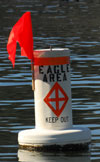 Enjoy bald eagles from outside the closures, especially during critical nesting times (December to June). These areas
are posted with signs and/or buoys, and most have daily nestwatch monitors. Anyone approached by a nestwatcher and asked
to cease an activity or leave a closed area should comply. A few good places to see bald eagles without disturbing them
(during December and January) are at Lake Mary and Mormon Lake near Flagstaff or on the Verde River Canyon Train in
Clarkdale.
Enjoy bald eagles from outside the closures, especially during critical nesting times (December to June). These areas
are posted with signs and/or buoys, and most have daily nestwatch monitors. Anyone approached by a nestwatcher and asked
to cease an activity or leave a closed area should comply. A few good places to see bald eagles without disturbing them
(during December and January) are at Lake Mary and Mormon Lake near Flagstaff or on the Verde River Canyon Train in
Clarkdale.
- Bald eagles protecting an active nest will let you know if you are too close. If a bald eagle is vocalizing and
circling the area frantically, you are too close and need to leave the area quickly. Bald eagles incubating eggs
or brooding small young should never be off the nest for more than 15 minutes.
- Pilots should maintain the FAA-recommended 2,000-foot Above Ground Level advisory when flying over bald eagle habitat along the
Salt and Verde Rivers, Lake Pleasant and Alamo Lake. These areas are designated on the Phoenix Sectional Aeronautical
Map. Special brochures for pilots regarding this advisory can be obtained by calling the Arizona Department of
Transportation or the Arizona Game and Fish Department's nongame branch.
- Help from anglers is especially needed. Monofilament and tackle have killed two nestlings and been found in
two-thirds of all bald eagle nests in the state. Every year we remove this potentially lethal material from nests
and/or entangled nestlings. Ospreys, shorebirds, waterfowl and songbirds also succumb to this litter. Do not
discard any type of monofilament along rivers and lakes, but recycle it at fishing stores. Keep your monofilament
fresh; do not use old brittle line. Make sure to use the correct test line for the fish you are trying to catch.
Also, do not cut the line when an undesirable fish is caught and return it to the water with the hook and line
attached.
You can help bald eagle research and recovery efforts by reporting any harassment or shooting of bald eagles. Call the
Arizona Game and Fish Operation Game Thief Hotline at (800) 352-0700 or U.S. Fish and Wildlife Service Law Enforcement
at (480) 967-7900.