Observations of bald eagles in Arizona are mentioned in the literature from as early as 1866 by Coues in
the vicinity of Fort Whipple (now Prescott), and in 1875 by Henshaw south of Fort Apache. Bald eagle bones
dated from 700 to 1300 AD were found in the Wupatki Pueblo along the Little Colorado River near Grand Falls
(Hargrave 1939). These remains suggest bald eagles may have been present in Arizona for centuries, although
it is possible that the bones resulted from trading with other regions.
The first breeding record was from a tree nest near Stoneman Lake on the Mogollon Plateau. Cited records include that of
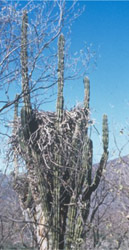
two nests in saguaro cacti on the lower Verde River in 1937 and a nesting pair on the Little Colorado River in 1951.
Phillips et al. (1964) reported nesting from the 1930s to 1960s on the Salt and Verde Rivers, including pairs breeding
during 1930-1936 near Saguaro Lake, since the early 1940s near Bartlett Reservoir, and in the free-flowing Salt River
Canyon in 1935, 1944, and 1949. Nesting was also observed on the Tonto Arm of Roosevelt Reservoir from 1951-55.
Additional records in the 1950s and 1960s are from Canyon Lake and upper Verde River..
Appearance
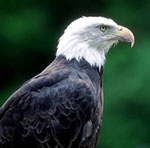
Adult females are larger than males (reverse sexual dimorphism), and northern, cooler climate bald eagles are
bigger than those in southern warmer climates (Bergmann’s Rule). Length of bald eagles varies from 28 to 38
inches, wingspread is 66 to 96 inches, and weight is from 6.5 to 14 pounds. A comparison study of breeding
bald eagles from Alaska, California, and Wyoming, showed that Arizona's male bald eagles were significantly
smaller in 81 percent of the cases and females in 61 percent.
The bald eagle's sub-adult plumage is one of the most varied of all North American birds. A one year old bald
eagle looks similar to a golden eagle. Flight feathers are typically black, while the outer-wing coverts, breast,
leg, and head feathers tend to be brown. Under-wing coverts, secondary flight feathers, wing pits, and tail are
brown and mottled with white. During their second year, belly feathers lighten, sometimes appearing completely
white. During their third year, the brown eye and gray beak turn cream and yellow respectively. The crown of
the head also lightens, giving the bald eagle an eye stripe similar to an osprey. At four years of age, bald
eagles retain their eye stripe, but the rest of the head turns white, the eye cream, and the beak yellow. The
tail will also change to white, except for brown mottling near the base and tip. The wings, breast, and belly
become brown.
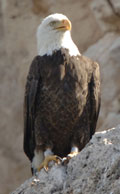
The adult plumage of a bald eagle is well known. At five years, they typically have a white head and tail,
cream eye, and yellow beak. The body is brown.
Some Arizona bald eagles have retained the eye stripe and brown mottling on the crown of the head and tail
into their seventh year.
More information about the different plumage stages of the bald eagle
Nesting Behavior
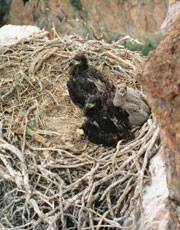 Arizona bald eagles tend to breed earlier in the year in comparison to northern populations. They lay one to three eggs
from December to March, but mostly in January and February. The eggs take 35 days to hatch with the female and male taking
turns incubating. Nestlings fledge at approximately 12 weeks after hatching (May and June) and are completely dependent
upon the adults for food until they migrate north.
Arizona bald eagles tend to breed earlier in the year in comparison to northern populations. They lay one to three eggs
from December to March, but mostly in January and February. The eggs take 35 days to hatch with the female and male taking
turns incubating. Nestlings fledge at approximately 12 weeks after hatching (May and June) and are completely dependent
upon the adults for food until they migrate north.
About 45 days after leaving the nest, the young migrate to Canada and northern California, Idaho, Montana,
North and South Dakota, Oregon, Washington, and Wyoming. Two and three year old bald eagles also migrate annually to
these destinations. It is unknown where non-breeding four year old and adult bald eagles travel to in late spring and
summer. One to three year-old sub-adults return to Arizona in September and October. Resident adults will stay in their
breeding areas year-round, although local short-term migrations are common.
Diet
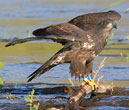
Bald eagles primarily eat fish, but they will also eat birds, amphibians, reptiles, small mammals, carrion (dead animals),
and carcasses of large mammals (cows, elk, deer, etc.). The most common fish eaten are Sonora and desert suckers; channel
and flathead catfish; common carp; largemouth, smallmouth, yellow, and white bass; and black crappie. Less common are
roundtail chub, green sunfish, bluegill, tilapia, and rainbow trout.
Wintering Population
During the winter, bald eagles migrating from the north are found in a variety of habitats throughout the state.
The winter bald eagles will follow the freeze line south to find more available prey items. Large numbers are
common at lakes and rivers along the Mogollon Rim and east throughout the White Mountains. Bald eagles are not
regularly found in large concentrations, but occasionally 30 or more bald eagles are present around Mormon Lake,
Upper and Lower Lake Mary, and on San Carlos Reservoir. Annual winter counts in January yield information on
the numbers of individuals, their age classes and the winter habitats they use. Through 102 standardized routes,
completed by state and federal agencies, Native American Tribes, and private groups, about 300 wintering bald
eagles are counted each year.
Breeding Areas (BA)
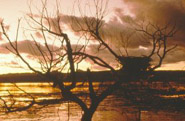
Arizona bald eagles typically place their nests within a mile of a creek, lake, or river.
Nests are placed mostly on cliff edges, rock pinnacles, and in cottonwood trees, however, artificial structures,
junipers, pinyon pines, sycamores, willows, ponderosa pines, and snags of these trees also have housed
eagle nests.
Bald eagle breeding areas vary in size depending on the resources available and the proximity of other breeding areas. Territory size, nest location, and resources are affected by availability of nest sites (cliffs, pinnacles, trees),
water system (regulated/unregulated river and/or impounded lake), and/or diversity and abundance of food.
Breeding areas on the regulated lower Verde River occur at the highest denisty in the state with eight breeding areas downstream of
Bartlett Dam above the Salt River confluence. At impounded lakes (Alamo, Pleasant, San Carlos) where few fish exist
in the source stream, they tend to forage within the lake's boundaries.
Distribution
Nearly all
breeding areas are in the central part of the state, along the Salt and Verde Rivers (two are in the east-central mountains). Nests are located on lands managed by the Arizona Game and Fish Department, Arizona State Land Department, McDowell Indian Community, Maricopa County Parks and Recreation Department, Salt River Pima Maricopa Indian Community, San Carlos Apache Tribe, Navajo Nation, Gila River Indian Community, U.S. Bureau of Land Management, U.S. Bureau of Reclamation, U.S. Fish and Wildlife Service, U.S. Forest Service, White Mountain Apache Tribe, and private
landowners. While these agencies have primary land management responsibility, these and other agencies (Arizona State Parks,
Army Corps of Engineers, National Park Service, Salt River Project, U.S. Department of Defense, U.S. Bureau of Indian Affairs,
U.S. Fish and Wildlife Service and Hopi Tribe) along with the general public are engaged in assuring the continued existence of the bald eagle in Arizona.
Arizona's Status and Management
The Arizona Game and Fish Department has included the bald eagle on its draft list of
Wildlife of Special Concern, replacing its previous designation as a
Threatened Native Wildlife in Arizona.
The list provides policy guidance to state and federal agencies and the public on
management priorities. It does not provide specific legal or regulatory protection
for listed species. However, as with all native wildlife in Arizona, the general
provisions of Arizona Revised Statutes, Title 17 protects bald eagles and all
threatened and endangered species.
Over 60 bald eagle breeding areas are known in Arizona. Most wildlife biologists
believe the distribution and abundance of breeding Arizona bald eagles has improved largely
due to intensive management. Some of the threats that led to listing the species (recreational
human activity, development, loss of habitat, etc.) have not diminished, but have increased. List of the
productivity summaries of bald eagle breeding areas from 1971 to 2012.
Key management programs, projects, and committees developed during the past two decades
have been critical factors in improving and conserving the species status: the
Arizona
Bald Eagle Nestwatch Program, the
Southwestern Bald Eagle Management Committee, the
Arizona Bald Eagle Nest Search, and Occupancy and Reproduction Assessment helicopter
flights. Without these efforts, management actions (i.e. seasonal breeding area closures),
and attention to habitat, Arizona breeding bald eagles may not retain their current
distribution and abundance.
National Distribution
Bald eagles nest near the coast, on inland lakes, or rivers. Alaska and Canada have the
largest breeding populations, estimated at over 55,000 individuals. In the lower 48 states, the breeding population has incresaed from less than 487 breeding pairs in the 1960's to nearly 10,000 pairs by 2007.
National Status and Protection
 The U.S. Fish and Wildlife Service classified the bald eagle in 1978 as endangered in 43 states (including Arizona)
and threatened in five others. The species was not listed in Alaska and it does not occur in Hawaii. In 1995,
the species was down-listed to threatened in all recovery regions of the lower 48 states. In 1999, the Fish and
Wildlife Service proposed to remove the bald eagle from the federal threatened and endangered species list nationwide. The bald eagle was delisted from the Endangered Species Act in 2007.
The U.S. Fish and Wildlife Service classified the bald eagle in 1978 as endangered in 43 states (including Arizona)
and threatened in five others. The species was not listed in Alaska and it does not occur in Hawaii. In 1995,
the species was down-listed to threatened in all recovery regions of the lower 48 states. In 1999, the Fish and
Wildlife Service proposed to remove the bald eagle from the federal threatened and endangered species list nationwide. The bald eagle was delisted from the Endangered Species Act in 2007.
Currently, the bald eagle retains protection under the Migratory Bird Treaty Act, Bald and Golden Eagle
Protection Act, Lacey Act, Airborne Hunting Act, and the general provisions of Arizona Revised
Statutes, Title 17. A recovery plan has guided management of the southwestern population of bald eagles
since 1982 (Arizona, New Mexico, California along the west bank of the Colorado River where it borders
Arizona, and Texas and Oklahoma west of the 100th meridian.)